Medication Abortion
What is Medication Abortion?
Medication abortion is an abortion with pills. Almost two-thirds of all abortions in the United States take place using this method,1 typically a two-step regimen of mifepristone (pronounced: mih-fuh-pris-tohn) followed by misoprostol (pronounced: my-soh-prah-stol) for pregnancies up to 12 weeks.
An abortion may also be administered by misoprostol only, also for pregnancies up to 12 weeks, and especially if mifepristone is unavailable, like in some countries outside the United States.
Whether the abortion is conducted with mifepristone and misoprostol or just misoprostol alone, "decades of research [show] that medication abortion is safe and effective, both when provided in person [at a clinic] or via telehealth."2
Follow this link to learn more about what to expect when using medication abortion pills. Learn more facts about medication abortion from our 2025 post here.
Medication Abortion Provided via Telehealth
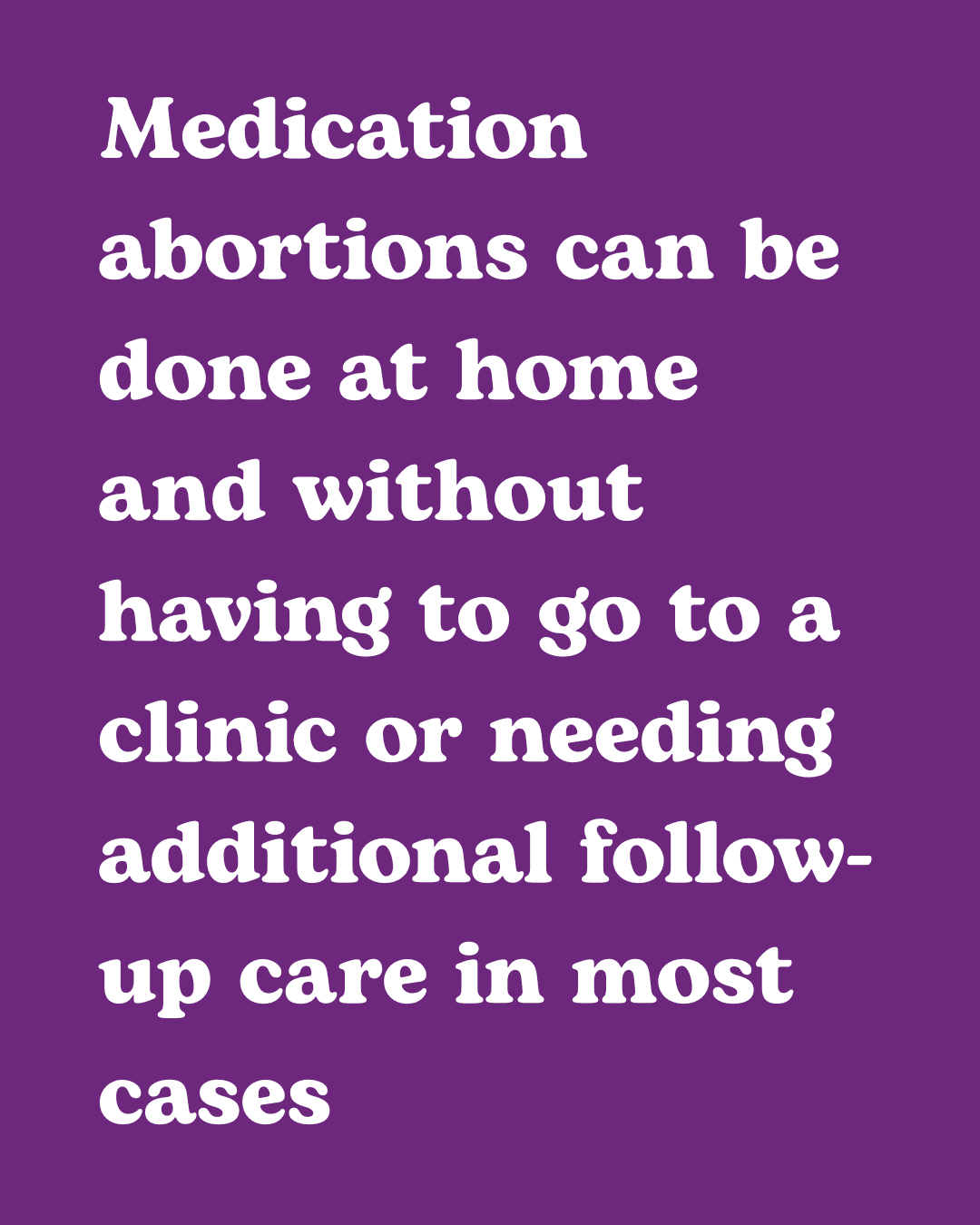
More than a quarter of all abortions in the U.S. today are provided via telehealth consultation.3 The pills are sent via mail, making it very convenient for people who cannot or do not want to travel to a clinic for in-person abortion care.
Administering abortion medications via telehealth has shown to be just as safe and effective as it is in person at a clinic. It's so safe that the FDA removed the in-person medication dispensing requirement in 2021 after reviewing science-backed evidence that telehealth consultation for abortion is safe.4 This method follows a standard of care that supports patients throughout the process, and there is even growing support for over-the-counter availability of abortion pills.5

Accessing Medication Abortion in North Carolina
Benefits of Medication Abortion and Telehealth Abortion Care



Anti-Abortion Threats Against Medication Abortions
May 2026: The U.S. Supreme Court stopped an attempted ban on the use of mifepristone that was brought by the state of Louisiana to the notoriously conservative U.S. Fifth Circuit Court.
For now, mifepristone is still able to be prescribed with misoprostol for medication abortion regimens, but it is expected that more court challenges against the use of mifepristone will come up again in the future as leaders in Washington D.C. are pressuring the FDA to conduct a review of mifepristone's safety. Even though the FDA approved the use of mifepristone in 2000 and even though there is no scientific evidence suggesting that mifepristone is unsafe when used as directed, anti-abortion activists are not stopping their attacks and are continuing to find ways to restrict access to this life-saving medication.
Please note that this a web page created by Pro-Choice North Carolina for educational purposes regarding abortion medications and does not constitute medical or legal advice. If you or someone you know is pregnant and needs help finding access to abortion care, whether you live in North Carolina or are traveling to North Carolina for care, please refer to our Guide for Accessing Reproductive Health Care in North Carolina. Additionally, free and confidential support for people navigating miscarriages and abortions is available. You can speak with a team of experienced doctors and nurses who provide abortion care via the M+A Hotline or find answers to legal questions with the Repro Legal Hotline.
Sources Cited:
1. https://www.guttmacher.org/2024/03/medication-abortion-accounted-63-all-us-abortions-2023-increase-53-2020
2. https://www.guttmacher.org/state-policy/explore/medication-abortion
3. https://societyfp.org/research/wecount/wecount-december-2025-data
4. https://www.ansirh.org/research/brief/us-studies-medication-abortion-without-person-clinician-dispensing-mifepristone
5. https://www.ansirh.org/research/sheet/facts-about-medication-abortion-care